
Explore how SAP R&D and Engineering Services connect product design, engineering data, procurement, and manufacturing to improve collaboration and innovation.

Research and Development departments are under constant pressure to innovate better products, reduce time-to-market, keep budgets in check, and cope with evolving customer requirements. All these challenges are harder to tackle when product designs, engineering data, materials knowledge, and business operations are stored in isolated environments. SAP R&D & Engineering Services enable companies to integrate product development with the company-wide processes and manage all information from initial design stages up to production and further product improvements.
These services may be useful for those who want to increase cooperation among engineering, procurement, manufacturing, financial, and logistics departments. The main advantage is in the link between the technical aspects of the decision-making process and operational aspects of the product delivery process.
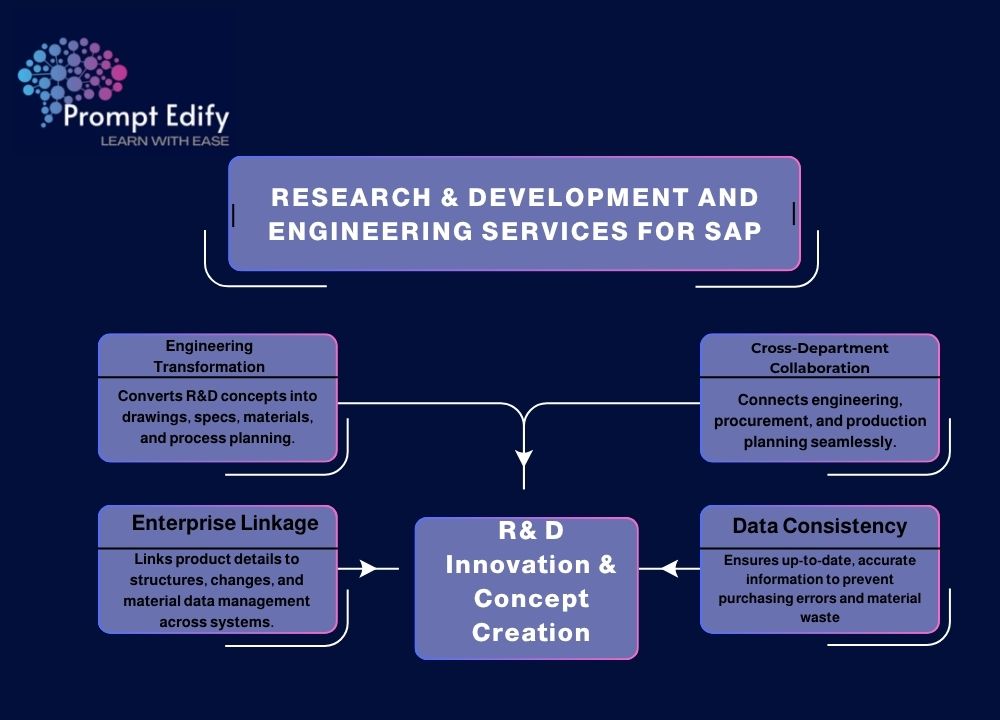
Research and development includes discovering new concepts, idea testing, innovation of current products, and using technology to deliver practical applications. Engineering professionals transform these concepts into drawings, specifications, materials, and process planning.
The capabilities of SAP software allow linking information about products with enterprise-wide processes, depending on the types of products selected and the configuration of the system used. It is possible to handle such issues as product structures, engineering changes, material data management, projects management, and collaboration among departments.
For example, an industrial company producing equipment develops a new machine. Engineers update the specification of a part, while the procurement department reviews suppliers and production planning prepares manufacturing plans. Using old and inconsistent information will result in a situation when the wrong material or parts will be ordered.
As more reliable and available information becomes available, decision-making can be improved in other areas too.
• Better cooperation between different departments: Engineering, purchasing, manufacturing, finance can operate with consistent product information.
• Increased awareness of costs: Material availability, purchasing and manufacturing aspects of the product can be taken into account earlier in its development.
• Increased traceability: Consistent documentation may assist in tracking what change was introduced and what product information was affected by it.
• Better planning: Manufacturing and supply chain teams can prepare themselves for future needs without surprises.
All the above depends on good data, clear responsibilities, and adherence to the process. While software may enhance visibility, it cannot substitute for lack of clear responsibility and good documentation.
Various businesses have different engineering needs. The automotive component supplier might require better management of revisions and coordination between engineering specs and manufacturers. The electronics company might have more rigorous control over product versioning, availability of components, and certification documents. The manufacturing company might have different priorities regarding equipment setup, maintenance, and handing over the product data to the service department.
The best approach is to determine what gaps in the process cause the biggest trouble or inefficiency for the organization. For example, the improvement can start with the optimisation of engineering change approval, linking the bill of materials and production planning, or unifying product data at all locations. The selection of a specific issue is a better way to measure the success than complete change of all processes at once.
The process of successful implementation begins with analyzing the current state. The companies have to understand how the creation, review, approval, and distribution of product information works. Companies also need to find duplicated entries, manual processes, and the interrelated systems that have to be integrated.
Before making any decision about implementing the process, ask yourself the following questions:
1. What product development or engineering processes require the most rework?
2. Who manages material data, product structures, documents, and changes?
3. Which SAP modules does your company use and which integration will be required?
4. How are the employees going to be educated on new workflows?
5. What indicators will show the progress – fewer errors, quicker approvals, or less delays?
Scoping must correspond to the level of business readiness. It is possible to introduce the process in phases and then to validate the information, check workflows, and fix issues. It is especially critical to involve engineering users at the beginning because even a technically right system will not work well if the daily process seems to be impractical.
Innovation in products is not solely dependent upon good ideas. Innovation also requires reliable information, sound decision making, and collaboration between those individuals responsible for designing, sourcing, manufacturing, and supporting products.
Companies need to start off by setting priorities, preparing data and ensuring that teams are aware of how the integrated processes will operate. To learn about the potential of SAP solutions and to find out which one works best for your company, contact Prompt Edify.
Contact: +27 740 294 414 | +91 99932 86938
Email: contact@promptedify.com
Website: https://promptedify.co.za/
By Team Prompt Edify
Have any enquiry? Call us
+(27) 740294414
(+91) 99932-86938
wecare@promptedify.com


Prompt Edify Africa (PTY) Limited
2nd Floor, Rivonia VillageCnr Mutual Road and Rivonia Boulevard Rivonia Village, 2191
Johannesburg , South Africa
Contact : +27740294414
Prompt Edify East Africa Limited
KN 78 ST, Kagarama, Kigali, Kigali, Nyarugenge, Umujyi wa Kigali, Rwanda
Contact : +250 727 845 771
Prompt Edify Private Limited
4th Floor #15, City Vista Tower, Fountain Road,
Kharadi, Pune(MH), India.
PIN- 411014
Contact : (+91) 99932 86938



Contact Us Today!
+27740294414 | (+91) 99932 86938 | +250 727 845 771
contact@promptedify.com | wecare@promptedify.com
🌐 https://promptedify.co.za/