
Discover how SAP S/4HANA Asset Management supports asset lifecycle management, maintenance planning, work orders, equipment reliability, and business efficiency.

The management of physical assets is a crucial task for any company. Production machines, machinery, cars, infrastructure, and other assets must work properly so that ordinary operations can run smoothly. Nonetheless, difficulties in the asset management process may arise when there are separate databases to keep maintenance schedules, equipment history, repair requests, and operational information.
SAP S/4HANA Asset Management is the solution in this case. It enables companies to manage their physical assets throughout their life cycles and perform maintenance operations, evaluate the efficiency of equipment used, and enhance overall operation efficiency.
SAP S/4HANA presents asset management as a part of business processes, thus giving a structured framework for maintenance planning and execution. In this guide for dummies, the concept of SAP S/4HANA Asset Management will be explained, its business objectives will be outlined, the essential maintenance processes will be presented, and key functions of this solution will be explained.
SAP S/4HANA Asset Management is a module in SAP S/4HANA that enables businesses to manage their physical assets throughout their lifecycle. This solution provides support in terms of maintenance planning, scheduling, execution as well as monitoring and analysis needed to maintain equipment and technical systems in good condition.
The solution provides maintenance teams with oversight over relevant asset data such as equipment data, functional locations, maintenance history, work orders, and schedules.
For instance, a manufacturing facility may have several machinery that must be serviced from time to time. Without a unified system of managing assets, it would be impossible for the maintenance team to keep track of the asset servicing history and plan the date for the next service.
The system integrates all processes involved in the asset management process.
The application builds on the concept of SAP Plant Maintenance.
SAP S/4HANA Asset Management is a module in SAP S/4HANA that enables businesses to manage their physical assets throughout their lifecycle. This solution provides support in terms of maintenance planning, scheduling, execution, as well as monitoring and analysis needed to maintain equipment and technical systems in good condition.
The solution provides maintenance teams with oversight over relevant asset data such as equipment data, functional locations, maintenance history, work orders, and schedules.
For instance, a manufacturing facility may have several machines that must be serviced from time to time. Without a unified system of managing assets, it would be impossible for the maintenance team to keep track of the asset servicing history and plan the date for the next service.
The system integrates all processes involved in the asset management process.
The application builds on the concept of SAP Plant Maintenance.
Maintenance teams are able to organize work based on their workload and availability of equipment. This minimizes interruptions in the production process and business activities overall.
The system offers tools to control maintenance requests, work orders, schedules, and technical data. Thus, maintenance planners are able to coordinate work activities and assign resources.
Asset history, costs for maintenance, efficiency of operations, and operational information will all help management make decisions concerning repair and replacement, as well as long-term investments into the assets.
SAP S/4HANA Asset Management presents a number of integrated maintenance processes. The knowledge of the processes can be used by beginners to learn how the solution operates in business.
Technical objects are composed of the physical assets and places that are to be serviced by companies.
The two most important types of technical objects are:
Equipment: The physical assets themselves - pumps, motors, machines and engines, vehicles.
Functional locations: A location of equipment installation, service or repair activity - production line, building, area of use, etc.
The records above allow organisations to generate information about assets and to find what maintenance is required and what the history of operation is.
Maintenance notifications are messages that describe technical issues, malfunctioning equipment, inspection results, or other maintenance requirements.
For instance, an operator may detect some unusual vibrations in a production machine, and he/she will record a maintenance notification to inform the maintenance teams about the problem.
Maintenance specialists will then look at the notification, analyze the problem, and take action.
Notifications enable companies to keep track of the issues with their equipment and gain useful information for maintenance planning.
Maintenance planning refers to the process of determining the actions necessary for the maintenance of technical systems and equipment.
The planners analyze notifications, technical details, materials, the amount of labor, and operational priorities before arranging the maintenance operations.
Effective maintenance planning allows organizations to efficiently organize maintenance work and utilize their resources effectively.
Work orders for maintenance help in the management of maintenance tasks. Work orders are capable of providing crucial information, including: the specifics of the equipment or location of the equipment, maintenance activity description, spare parts or materials that should be used, workforce and resource requirements, and timeline. In other words, for instance, a certain device may require replacing a motor; hence, the maintenance group will use a work order to do the repairs, find out the materials needed, plan out the steps, and report on the completed activity.
The goal of maintenance prevention is to conduct necessary maintenance. For instance, a certain manufacturing company may plan to only check key equipment once every month. SAP S/4HANA Asset Management supports maintenance planning and scheduling processes, enabling companies to perform routine maintenance activities.
The process of fixing a flaw in the machine or solving the issues concerning it is referred to as corrective maintenance. The process begins when an issue is raised, whether through the maintenance notice or the process of maintenance.
The next step of the maintenance process involves evaluation of the problem, planning of the work required, generation of the maintenance order, and finally, performing repairs.
Corrective maintenance is important in ensuring that organisations are able to restore equipment to its operable condition.
After the approval of maintenance work, technicians carry out the required work concerning the maintenance.
The maintenance process may consist of recording the work done, confirming the work completed, stating the hours spent doing the work, using spare parts, and writing down the technical report.
The information from the completion stage is required by businesses to keep accurate histories of maintenance performed on the equipment.
SAP S/4HANA Asset Management combines several functions for asset and maintenance-related business processes.
The main characteristics of SAP S/4HANA include the following:
1. Equipment Management: Provides data on particular pieces of equipment, technical specifications, location of installation, and history of maintenance activities.
2. Functional Location Management: Classifies the assets based on the real location or the status of operation.
3. Maintenance Notifications: Documents the equipment functionalities, maintenance requests, and technical comments.
4. Maintenance Order Management: Enables planning, execution, organization, and closing of maintenance work.
5. Maintenance Planning and Scheduling: Helps with organizing preventive or corrective maintenance activities.
6. Maintenance History: Keeps previous records of all restoration activities and equipment status, allowing for evaluation of the performance of the asset and future planning.
7. Spare Part Integration: Connects maintenance needs with material management and supply management.
8. Maintenance Analytics: Analyzes maintenance operations, costs incurred, and efficiency of assets when reporting and performing analytical functions.
Enterprise Asset Management (EAM) deals with the methods, plans, and innovations that organisations use to manage tangible assets throughout their life cycle.
EAM includes measures, which include acquisition of assets, their installation, usage, maintenance, monitoring, and removal of assets.
SAP S/4HANA Asset Management connects maintenance operations with corporate operations and is important for EAM processes.
Namely, maintenance practices are directly connected with material management, finances, procurement, and production.
For instance, the maintenance process is generally dealing with some parts being replaced.
When maintenance is done, the actual cost of the maintenance procedure is recorded through the financial system.
The connection between these processes allows for a better understanding of the absence of the asset in question and the costs incurred. That is due to the fact that there are different stages of maintenance allowing for easier records of the process as well as the overall expenditures.
For organisations making use of many facilities or sophisticated operations, the opportunities provided by SAP S/4HANA asset management enable an increase in quality of maintenance.
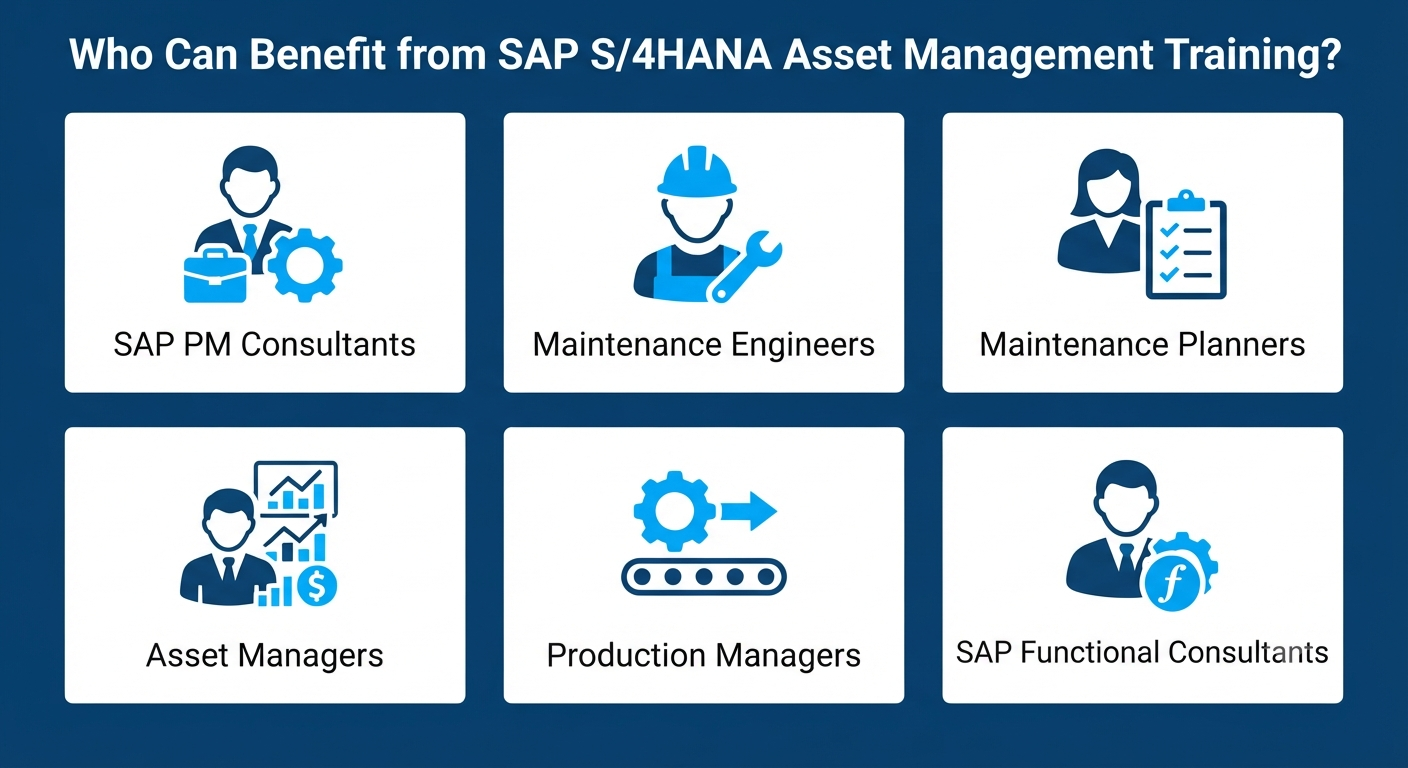
SAP S/4HANA Asset Management training is important for professionals interested in the field of asset management, enterprise asset management, and operational consulting.
The following professionals may find value in learning about this application:
SAP Asset Management courses help the learners to understand the fundamentals of asset management and maintenance that takes place within SAP.
A properly organized course will provide the learners with the theoretical knowledge of fundamental areas such as maintenance notifications, maintenance orders, technical object management, preventive and corrective maintenance, and maintenance planning.
It will also help the learners to know about the connection of asset management with materials management, finance and procurement.
Beginners should know how the requirements of business maintenance correlate with processes of SAP. Those professionals who worked with SAP PM may continue their training to learn more about the new capabilities and the changes introduced in maintenance.
The Prompt Edify company provides learners with SAP Asset Management courses that will help them gain knowledge of SAP maintenance business processes. The content of a particular course, and the manner of its presentation, will be discussed by the learners and the training provider.
SAP S/4HANA Asset Management allows companies to manage their physical assets, carry out maintenance processes, maintain the safety and reliability of their equipment, and monitor the costs related to these processes. Among others, the system covers such processes as technical object management, maintenance notification processing, work order processing, performing preventive maintenance, corrective maintenance, and maintenance execution.
As part of an enterprise asset management program, it integrates maintenance processes into business processes, making it easier for a company to make the best possible decisions.
By learning how to use SAP S/4HANA Asset Management, professionals gain an important base knowledge that can be useful both for beginners and experienced professionals.
Want to learn more about SAP Asset Management? Check out SAP Asset Management Course offered by Prompt Edify that will give you the foundations of the system and help you understand the maintenance processes that are conducted using SAP.
By Team Prompt Edify
Have any enquiry? Call us
+(27) 740294414
(+91) 99932-86938
wecare@promptedify.com


Prompt Edify Africa (PTY) Limited
2nd Floor, Rivonia VillageCnr Mutual Road and Rivonia Boulevard Rivonia Village, 2191
Johannesburg , South Africa
Contact : +27740294414
Prompt Edify East Africa Limited
KN 78 ST, Kagarama, Kigali, Kigali, Nyarugenge, Umujyi wa Kigali, Rwanda
Contact : +250 727 845 771
Prompt Edify Private Limited
4th Floor #15, City Vista Tower, Fountain Road,
Kharadi, Pune(MH), India.
PIN- 411014
Contact : (+91) 99932 86938



Contact Us Today!
+27740294414 | (+91) 99932 86938 | +250 727 845 771
contact@promptedify.com | wecare@promptedify.com
🌐 https://promptedify.co.za/