
SAP S/4HANA Manufacturing explained: explore planning, MRP, scheduling, master data, procurement integration, and the benefits of connected operations at scale.

The manufacturing company needs to coordinate their production activities, keep up the required stock levels, satisfy customers, and minimize costs of operations. Coordination of these processes in an isolated manner will result in the delay of production, lack of materials, and inefficient utilization of resources. This is where SAP S/4HANA Manufacturing comes into play.
SAP S/4HANA Manufacturing facilitates coordinated planning, scheduling, material and manufacturing processes within the integrated enterprise resource planning (ERP) system. The system provides a better view on production processes and integrates manufacturing processes with other business processes.
This guide will help you understand what SAP S/4HANA Manufacturing is in more detail.
SAP S/4HANA Manufacturing is a collection of manufacturing functions within the SAP S/4HANA ERP platform, which aids enterprises in planning and controlling their manufacturing operations.
The software connects the manufacturing operations to purchasing, inventory management, sales, accounting, and other business functions.
The software allows for different manufacturing methodologies, such as discrete manufacturing, process manufacturing, and repetitive manufacturing.
Based on the real-time business information and planning functionality, the decision about production needs, available resources, and material consumption can be made.
Manufacturing solutions by SAP assist companies in improving collaboration among production planners, purchasing department, warehousing department, and other departments.
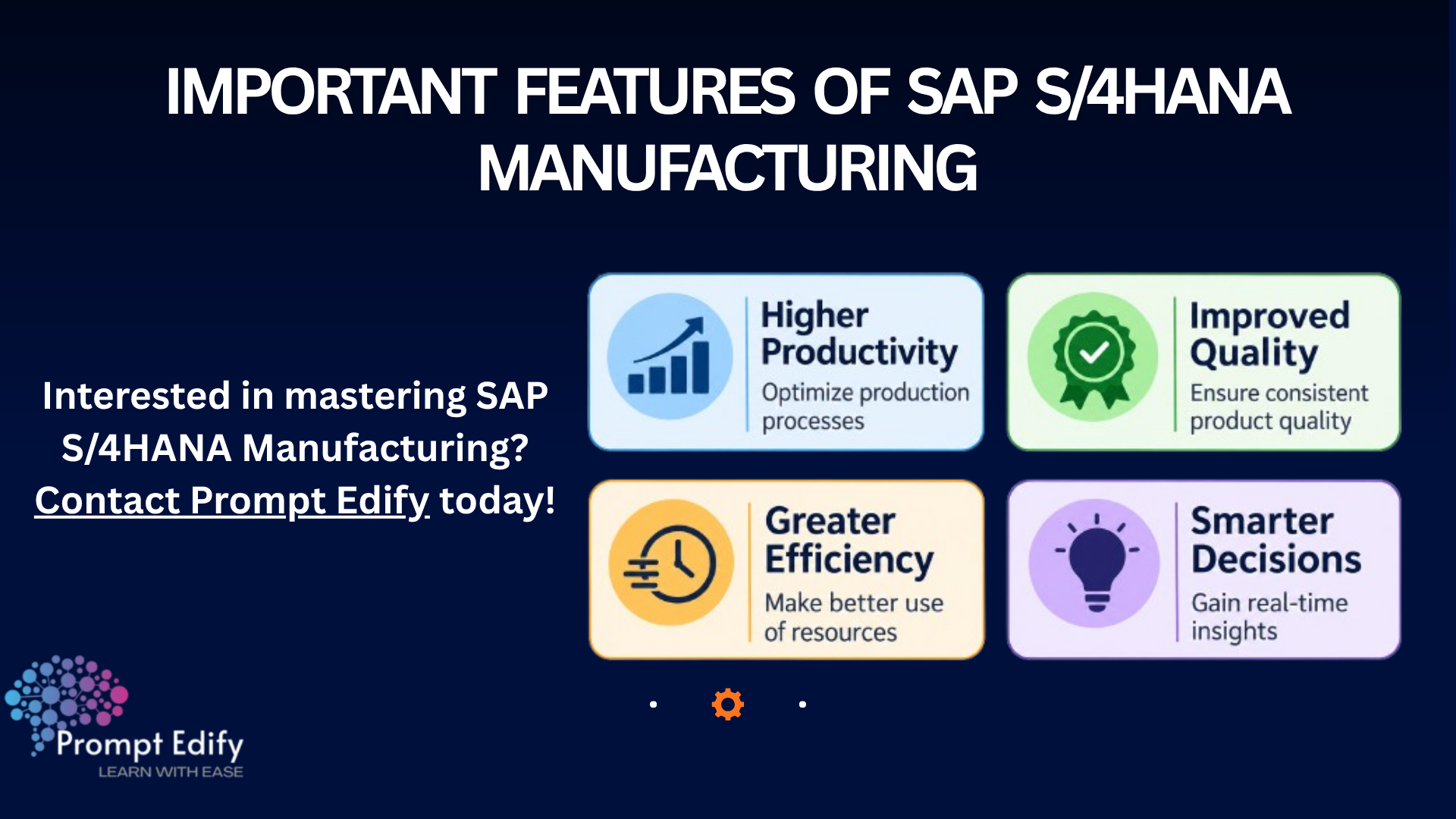
Some key features of SAP S/4HANA that help in conducting smooth manufacturing operations include:
Production planning is helpful for manufacturers as it enables them to plan what kind of products have to be produced and in what quantities, as well as when the production process has to start.
SAP S/4HANA offers production planning according to customer demands, sales forecast, inventory, and production capacities.
Material Requirements Planning (MRP) is one of the critical elements in the SAP manufacturing procedure. MRP is used by firms to plan what materials are necessary for production.
The factors that need to be considered in MRP are:
As such, MRP generates procurement proposals such as planned orders and purchase requests.
It helps companies to have adequate materials for production without surplus.
This refers to the scheduling of when manufacturing operations will occur and which resources are used to perform such operations.
Capability Manufacturing SAP S/4HANA manages production scheduling and capacity planning by assisting to analyze work centres, availability of machines, production duration, and required resources.
Dealers are able to see bottlenecks, prioritise production, re-schedule and so on when something extraordinary happens.
If your planning needs are more complex, then the more advanced functionality of PP/DS has the ability to support finite scheduling and resource-constrained planning.
Manufacturing master data is the basis for production activities SAP S/4HANA Manufacturing utilizes manufacturing master data to execute and administer all activities relating to the planning and processing of manufacturing, and material management.
Important master data items:
Drive better planning accuracy and reduce factory-floor error with one solution to master data improvements.
Manufacturing in SAP S/4HANA Manufacturing processes are connected, guiding production requirements from planning through to execution.
The main steps are:
Step 1: Demand Planning
The cycle is initiated with the determination of product demand by the use of sales orders, forecasts and planned independent requirements.
Step 2: Material Requirements Planning
MRP examines material requirements, on hand stock, and lead time for procurement of stocks to check if the stock can be fulfilled.
Step 3 - Production Planning
Planned orders are created by production planners according to material and demand. Planned quantities are established.
Manufacturing operations are assigned to those work centres which are free and scheduled according to work priorities and resource capacity.
Step 5: Production Activities
The planned orders are released as production order. Production personnel perform the required operation, record the consumption of the material, and verify the production.
Step 6: Inventory Updates and Goods Receipt
After the production is over, the finished goods are taken into stock. Stock records are prepared to show the amount of consumption of the material and the availability of the finished goods.
With this complete process, companies have more structure and control over their manufacture.
Connectivity with Purchasing and Stock Control
One of the important benefits is that SAP S/4HANA Manufacturing is integrated with the management of inventory and purchasing.
Lack of materials and components will affect manufacturing. Where the netting calculation via MRP indicates that there is a lack of material or components, a proposal can be generated to generate ordering proposals.
Inventory of the materials is updated as soon as they are ordered and delivered. Production departments use the data for verifying the presence of the materials.
Likewise, if production takes production from raw materials, the updated inventory figures of raw materials are posted to the items through the respective goods movements and the consumption posting.
The implementation of this synergy helps purchasing, warehouse and manufacturing departments to work more closely and eliminate the shortages and exces of stock.
SAP manufacturing solutions can provide advantages at many levels in the following ways:.
1. Improved Production Efficiency: If planned and executed properly, the implementation process can help to minimize delays
and coordinate manufacturing activities.
2. Live inventory transparency: It helps your business to keep the optimal stock levels and prevent overstocking of material.
3. Better planning accuracy: MRP and production planning feature helps organisations identify what material needs to be available and plan production accordingly.
4. Improved Resource Utilisation: Through capacity planning and scheduling, manufacturers can make better use of their machines, work centres and other resources.
5. Greater Business Visibility: All-in-one data offer increased visibility of the current production status, material status, and operating performance.
6. Faster Decision-Making: With current information of the business, production managers and production planners can make quicker decisions.
SAP S/4HANA Manufacturing SAP S/4HANA Manufacturing offers a single platform for overseeing modern manufacturing operations. It manages production planning and MRP, scheduling, master data, purchasing integration, and more.
With this knowledge, production managers can grow their knowledge of SAP manufacturing and start to look at job options in production planning and control.
Learn SAP S/4HANA Manufacturing. SAP S/4HANA Manufacturing Course online training is suitable for working professionals to gain hands-on experience on the manufacturing process and SAP S/4HANA systems. Check SAP S/4HANA Manufacturing Course outline to know the topics that are covered in the course and then apply for the course.
Interested in mastering SAP S/4HANA Manufacturing? Contact Prompt Edify today to explore our expert-led training, gain practical SAP knowledge, and take the next step toward your career growth.
By Team Prompt Edify
Have any enquiry? Call us
+(27) 740294414
(+91) 99932-86938
wecare@promptedify.com


Prompt Edify Africa (PTY) Limited
2nd Floor, Rivonia VillageCnr Mutual Road and Rivonia Boulevard Rivonia Village, 2191
Johannesburg , South Africa
Contact : +27740294414
Prompt Edify East Africa Limited
KN 78 ST, Kagarama, Kigali, Kigali, Nyarugenge, Umujyi wa Kigali, Rwanda
Contact : +250 727 845 771
Prompt Edify Private Limited
4th Floor #15, City Vista Tower, Fountain Road,
Kharadi, Pune(MH), India.
PIN- 411014
Contact : (+91) 99932 86938



Contact Us Today!
+27740294414 | (+91) 99932 86938 | +250 727 845 771
contact@promptedify.com | wecare@promptedify.com
🌐 https://promptedify.co.za/