
Discover how SAP SuccessFactors Migration streamlines HR operations through accurate data transfer, cloud-based solutions, better reporting, and improved workforce management.

Keeping track of employee data through legacy HR systems may lead to challenges for an expanding company. Lack of integration of employee data, manual process of payroll calculation, limited reporting capabilities, and time-taking recruiting procedures may complicate the work of HR departments. SAP SuccessFactors Migration allows enterprises to migrate all the data, processes, and systems of the HR department into a more advanced, cloud-based world.
The HCM cloud-based solutions of SAP SuccessFactors include employee administration, recruiting, performance management, learning, and workforce planning. However, migration into such an environment means more than just the transfer of data from one system to another. The organisation needs to perform analysis of current processes, preparation of proper data and employees' adaptation to new conditions.
Learning About SAP SuccessFactors Migration
The term SAP SuccessFactors Migration implies the transfer of HR data, configuration and other business processes from the legacy HR systems to SAP Success Factors. The migration may include different information depending on the needs of the organization such as the data related to employees, oganizational structure, positions, salaries, performance and recruitment.
For instance, when an organization uses spreadsheets and HR systems for handling information related to its employees, it might have difficulties in creating accurate reports on its employees. It would be easier to migrate to SAP SuccessFactors and centralize all information about the employees.
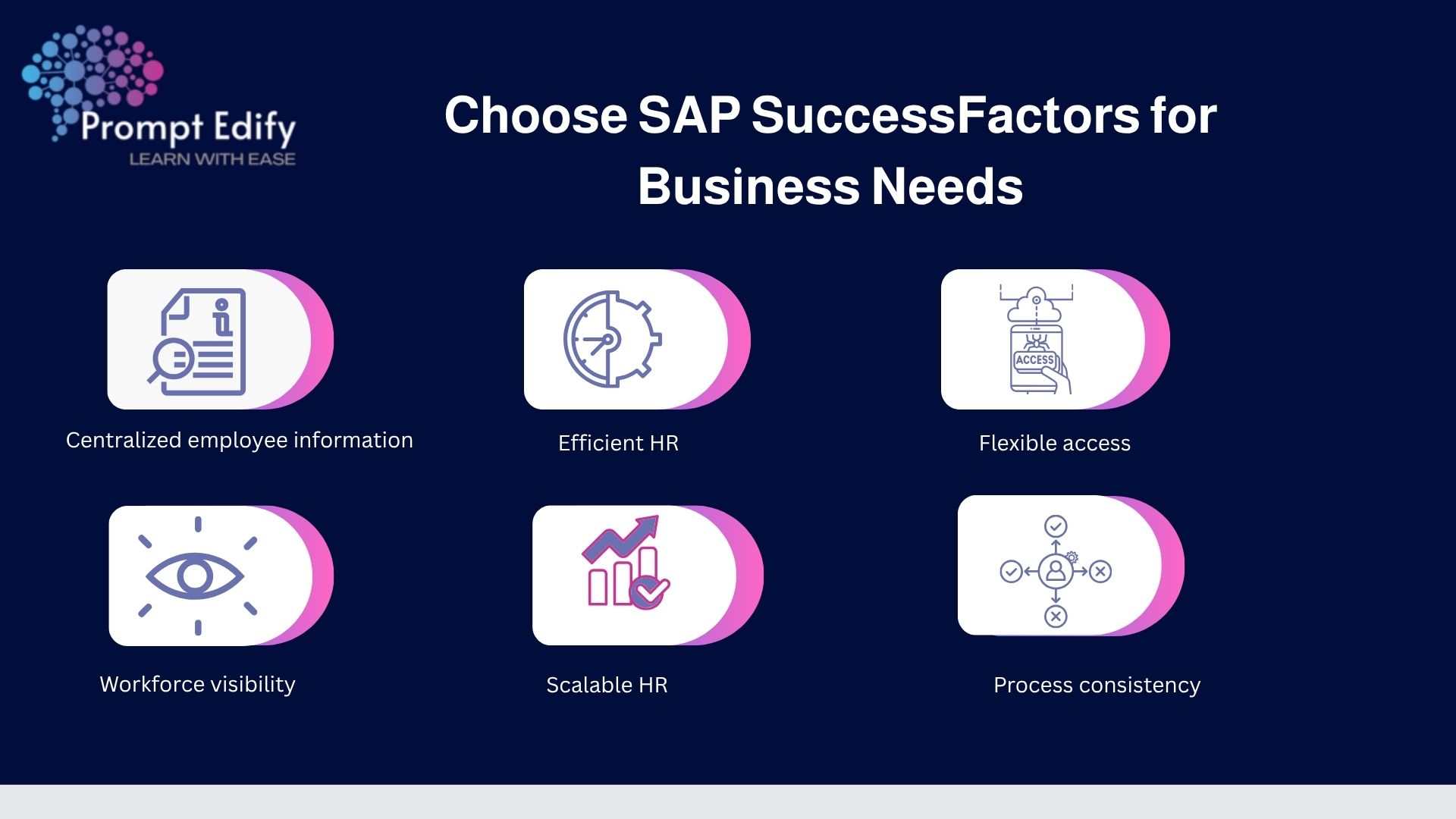
Transformation of HR cannot be limited only to implementation of new technology but rather to implementation of a more effective way of handling people, information, and organizational responsibilities.
There can be several grounds for business to migrate:
• Centralized employee information: Collect related records of your workforce in one HR system.
• Efficient HR: Simplify administrative procedures and automate regular employee processes.
• Workforce visibility: Facilitate reporting and analysis for workforce planning and decision-making.
• Flexible access: Provide employees and managers with ability to access HR-related processes via cloud service.
• Scalable HR: Adjust HR processes in accordance with company growth and Organizational restructure.
• Process consistency: Ensure better workflows for onboarding, performance review, and employee development.
All the advantages will depend on particular modules used, system settings, quality of the data entered and overall efficiency of using the platform by the company.
To conduct a successful migration process, a comprehensive migration plan should be developed that would link technical aspects to daily operations of HR. All steps are performed in order to avoid any disruptions and ensure further functioning of the company.
Step 1. Assess Current HR Environment
The first step of the process is to assess the way in which the data about employees is stored. In particular, it means to identify current HR applications, spreadsheets, integrations, reports and manual processes.
Thus, migration teams will be able to understand what kind of data needs to be migrated, what processes should be improved and what historical data could be archived.
Step 2. Prepare HR Data for Migration
Data preparation is one of the most important stages in the migration process. Problems with duplicating employee records, outdated job titles, different department names and incorrect information may occur.
It is extremely important for both HR and IT teams to verify all data including employee identifiers, organizational structure and employment data before performing the migration process.
3. Selecting the Right SuccessFactors Modules
Companies need to consider which of the modules are relevant for their HR strategy and do not deploy all the possible modules for the sake of deploying them.
Scope selection determines data mapping, system configurations, integration, testing and user training.
4. Data Mapping and System Configuration
At this step, the data migration team maps the data from existing systems to the right places in SAP SuccessFactors. Format, organizational structure, workflow, permission settings, and integration points should be considered at this step.
For example, the department name of the employee in the legacy database system may differ from the one set up in the new system. It is easier to solve these problems during the preparation phase than during migration itself.
5. Test, validate and go live
Prior to go-live, the migration team needs to test migrated data and business processes, access rights, reporting functionality, and integration capabilities. The comparison of source and target data sets, resolution of discrepancies, and validation of critical HR processes need to be carried out.
The pilot run of the migration process allows uncovering issues prior to implementation of the actual migration. Once the results are approved by the organisation, the production migration will be completed.
Any project can face some difficulties even if it is well-considered. Knowing what challenges you might face at the outset helps to solve them.
Inaccuracies in data: The data that is incorrect or missing may cause problems with reporting and employee management. It is recommended to set up validation rules for data and define its owners.
Difficulties with integration: Human resource management software can communicate with payroll systems, finance systems, identification systems, and time tracking applications. One needs to know their integration needs and test data exchange between connected applications.
Resistance of employees: Both employees and managers will not be aware of the new processes. One should train them according to roles and show how to use the new system.
Disruption of business operations: Without proper preparations, migration can influence the HR operations negatively. One needs to make a realistic schedule and define the responsibilities and contingency plan.
Once migration is done, the organisation needs to review whether the new environment achieves its desired results. These include the accuracy of employee data, successful completion of migrations, integration effectiveness, adoption by users, HR transactions time, and unresolved issues.
Such reviews will make sure that SAP SuccessFactors continues to address the changing requirements of the business rather than becoming another system requiring manual effort.
An efficiently done SAP SuccessFactors Migration will go a long way in ensuring that an organization creates a highly integrated, efficient, and robust HR environment. All this begins from preparing employee records, choosing the right modules, and even helping employees adjust to the change in systems. For organizations that make their decisions based on their future aspirations, they lay the foundation for future success.
Prompt Edify helps professionals and organizations in creating SAP expertise through industry-specific training and learning. Learn more about Prompt Edify today to enhance your SAP expertise.
Contact: +27 740 294 414 | +91 99932 86938
Email: contact@promptedify.com
Website: https://promptedify.co.za/
By Team Prompt Edify
Have any enquiry? Call us
+(27) 740294414
(+91) 99932-86938
wecare@promptedify.com

Prompt Edify Africa (PTY) Limited
2nd Floor, Rivonia VillageCnr Mutual Road and Rivonia Boulevard Rivonia Village, 2191
Johannesburg , South Africa
Contact : +27740294414
Prompt Edify East Africa Limited
KN 78 ST, Kagarama, Kigali, Kigali, Nyarugenge, Umujyi wa Kigali, Rwanda
Contact : +250 727 845 771
Prompt Edify Private Limited
4th Floor #15, City Vista Tower, Fountain Road,
Kharadi, Pune(MH), India.
PIN- 411014
Contact : (+91) 99932 86938



Contact Us Today!
+27740294414 | (+91) 99932 86938 | +250 727 845 771
contact@promptedify.com | wecare@promptedify.com
🌐 https://promptedify.co.za/