
Learn SAP Territory Management, including territory structures, account mapping, sales team assignments and territory planning to improve sales coverage.

As the organization expands and the sales force covers various regions, customer segments, and markets, managing all this becomes increasingly difficult. There arises a need to ensure that salespeople understand what customer accounts they cover, and there is a need for monitoring the performance of each region as well as ensuring that important customer accounts do not slip through.
This is where SAP Territory Management comes into play. It assists organizations in organizing their sales territories, assigning customers to these territories, managing territory teams, and improving sales coverage. This information can be helpful for beginners to understand how this process works.
What is SAP Territory Management? It is a sales management tool which enables organizations to create and manage their sales territories in accordance with their needs. The territory refers to a certain region that has been assigned to salespersons or sales teams.
There are various parameters which can be used when creating territories, and some of these include geographic regions, customer segments, industries, size of businesses, and sales potential. For instance, an organization that operates in South Africa can decide to divide its sales into Johannesburg, Cape Town, and Durban regions.
Every territory can be assigned its accounts and sales persons.
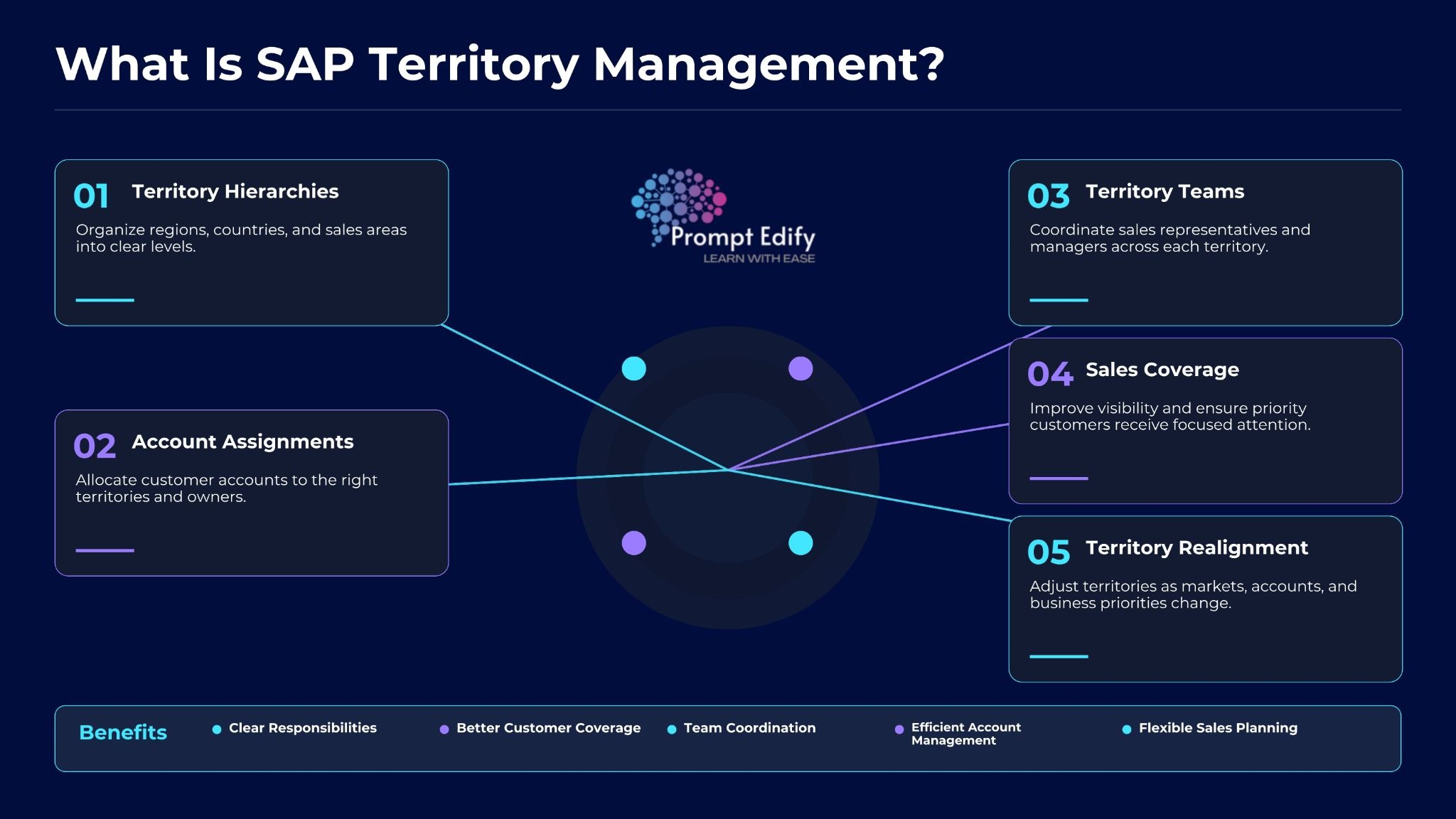
SAP Territory Management works by providing a structure to organise the responsibilities for sales. Companies are able to set up hierarchies of territories, allocate customers, link sales forces and sales coverage monitoring.
The key elements are:
Territory hierarchies show how territories of sales are organised in an organization. Organizations can set up hierarchies at various levels according to regions, customer types and organisational structures.
For instance, an organization is able to build a hierarchy by starting from a territory called Africa, where territories South Africa, Kenya and Nigeria will follow next. Each of the territories above may be further subdivided into sub-territories according to cities or business regions.
Hierarchies are helpful for sales managers in organizing their reporting lines and understanding the contribution of each territory to overall sales performance.
Account assignment refers to the method of allocating a sales territory or sales representative to handle the customer’s account.
A business organization may allocate its accounts based on location, industry, financial capacity, or any other business criteria. For example, a manufacturing customer in the area of Johannesburg would be allocated to the manufacturing sales territory in Johannesburg.
Correct account assignment helps avoid confusions among sales representatives.
Territory teams refer to the sales representatives and other staff members who take care of activities in a particular territory.
According to the needs of the organisation, the team members include account managers, sales executives, regional managers and other sales people.
The clear responsibilities of the team help coordination and enable the management to manage the customers efficiently. Sales managers can easily know which staff member is responsible for which account or which regional sales activities.
Sales coverage refers to the efficiency of the distribution of the sales force in various territories and customer accounts.
An organisation must ensure that their key customers are properly covered, and also identify those regions or market segments that may be having insufficient coverage in sales.
With SAP Territory Management, an organisation can easily arrange such responsibilities and cover up deficiencies in sales coverage. For instance, in a region where there are many customers, but less sales force, managers can arrange their territories and responsibilities.
The needs of business and market circumstances are subject to change as time passes. The entry of new customers to the market, growth of current clients and shifting of salespersons from one group to another is common.
Territory re-allocation is the process whereby these changes are taken into account and the structure of territories, accounts and sales are adjusted accordingly.
For instance, if a firm decides to venture into a new town, it might allocate a separate territory to its sales department. Similarly, in case there are too many accounts for a certain territory, some sales responsibility can be shifted.
There are many advantages that can be gained by adopting a process of territory management.
This will enable companies to establish coordinated sales processes and strong customer relationships.
The study of SAP Territory Management is applicable to individuals employed as sales professionals, sales operations managers, account managers, regional sales managers, CRM consultants, and business analysts.
It is also useful to individuals who are new to SAP Sales & Customer Experience products and want to know more about them. Learning about territory management will help you gain knowledge about the use of territories for managing customers and planning sales.
SAP Territory Management enables organisations to provide a structure to their sales operations through territorial planning, account assignment, sales team management, and efficient market coverage. With processes that range from creation of territory hierarchies to realignment, organisations are able to allocate sales responsibilities according to the changing requirements of the organisation.
For beginners, understanding these terms is the first step towards gaining knowledge on SAP sales management solutions.
Prompt Edify enables future professionals and working professionals to gain practical SAP knowledge through well-structured learning programs. Learn more about SAP Territory Management Training and gain knowledge of territory management concepts.
Learn more about other SAP learning programs at Prompt Edify.
By Team Prompt Edify
Have any enquiry? Call us
+(27) 740294414
(+91) 99932-86938
wecare@promptedify.com


Prompt Edify Africa (PTY) Limited
2nd Floor, Rivonia VillageCnr Mutual Road and Rivonia Boulevard Rivonia Village, 2191
Johannesburg , South Africa
Contact : +27740294414
Prompt Edify East Africa Limited
KN 78 ST, Kagarama, Kigali, Kigali, Nyarugenge, Umujyi wa Kigali, Rwanda
Contact : +250 727 845 771
Prompt Edify Private Limited
4th Floor #15, City Vista Tower, Fountain Road,
Kharadi, Pune(MH), India.
PIN- 411014
Contact : (+91) 99932 86938



Contact Us Today!
+27740294414 | (+91) 99932 86938 | +250 727 845 771
contact@promptedify.com | wecare@promptedify.com
🌐 https://promptedify.co.za/