
Discover what SAP WM is, its key components, storage bins, transfer orders, warehouse processes, WMS differences, and how it improves inventory management.
Efficient management of the operations carried out at the warehouse is very important for businesses with large volumes of inventory, products and orders from customers. Organizations require an effective method for tracking inventory and storage locations along with managing their warehouse operations. This is where SAP WM becomes very important. However, what is SAP WM, and how can it be useful to improve warehouse operations?
SAP WM is a warehousing management software which helps organizations to manage the movement of inventory, monitoring storage bins, transfers, and more for improved warehouse efficiency.
SAP WM (Warehouse Management) is a module of SAP ERP system, which aids businesses to manage and control their warehouse operations. With the help of SAP WM, companies can monitor and keep track of inventory on a storage bin basis as well as the movement of the material in the warehouse.
Learning the basics of SAP WM is crucial for individuals engaged in inventory management, logistics, and supply chain operations. SAP WM is used for carrying out tasks like goods receipt, put away, pick, pack, transfer stock, and conduct physical inventory.
In contrast to simple inventory tracking, SAP WM gives detailed information regarding the location and movement of materials from one location in the warehouse to another location.
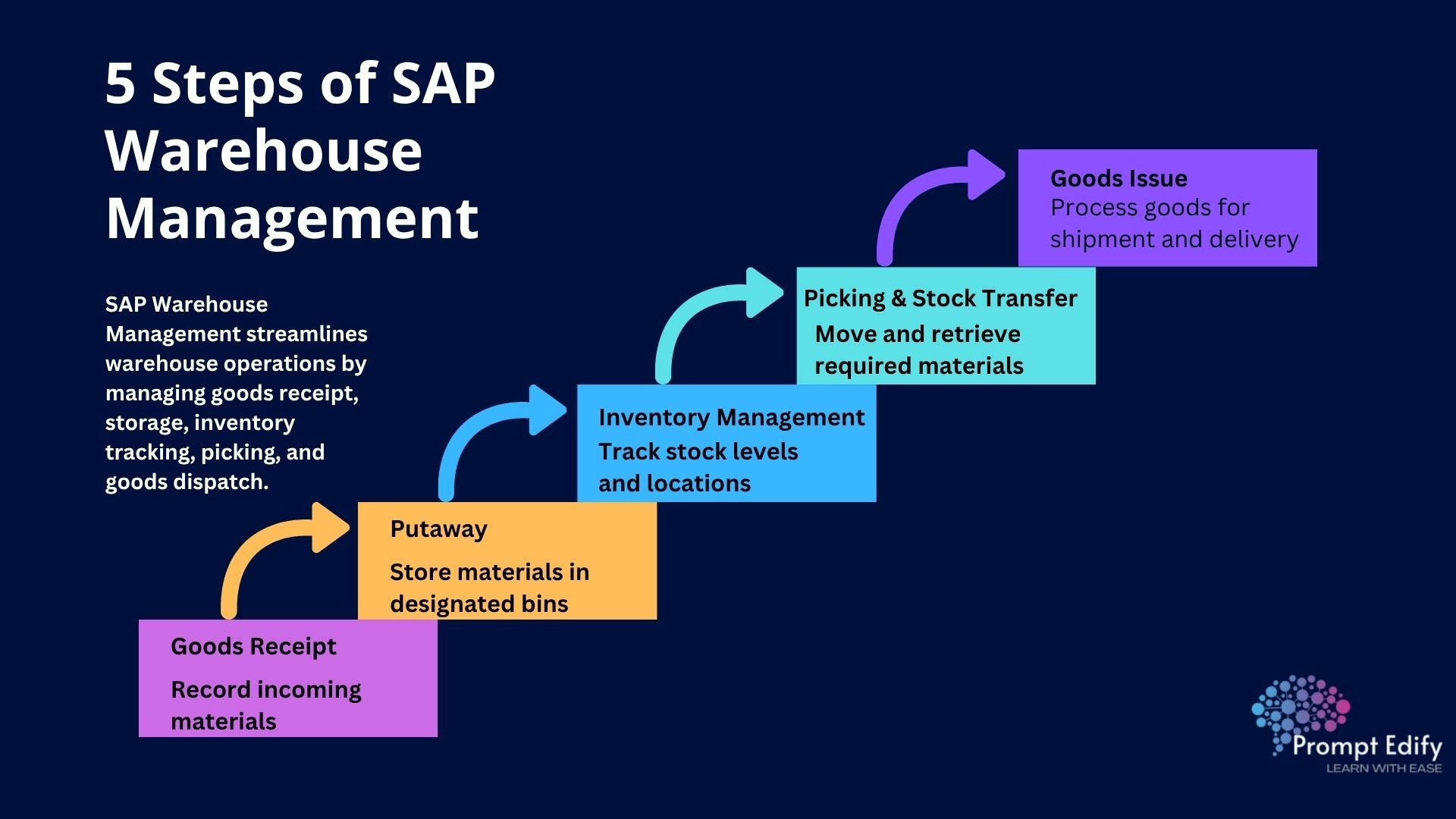
The SAP Warehouse Management System works through the process of managing warehouse processes. The process begins from receipt of material at the warehouse to the time when material is picked up and shipped out.
This is how the process is carried out:
SAP WM consists of numerous key components that enable warehouse management and inventory control.
The warehouse structure describes the warehouse setup in SAP. It involves warehouse numbers, storage types, storage sections, and storage bins. The warehouse structure makes it possible for enterprises to organize and control their inventory.
Storage bins are physical storage places within the warehouse that allow storing of materials. In SAP WM, inventory is controlled on the level of storage bins.
The transfer requirements show the necessity to conduct material movement within the warehouse. The transfer requirements are used to start material movement.
Transfer orders are the documents that help conduct physical movements of stocks within the warehouse. The document contains information on source and target storage bins, materials, and the quantity of materials to move.
Quant management helps enterprises monitor individual quantities of stocks based on material, batches, and other criteria for stocks.
This component allows companies to conduct stock count and to evaluate inventory differences.
Warehouse Management System (WMS) refers to software that helps in the management of warehouse operations including stock control, receiving, picking, packing, and shipping.
On the other hand, SAP WM is simply an example of the WMS systems that can be installed within the SAP ERP framework.
The following are some of the differences between the two concepts:
The SAP WM (Warehousing Management) is the warehouse management module of SAP ERP system while the general WMS (warehouse management system) is an independent software or integrated system that controls warehouse operations.
As far as integration is concerned, SAP WM is meant to be integrated with the SAP ERP system and will allow businesses to link warehouse operations to other business operations. The integration with general WMS depends on the software and whether it can be integrated with other business application systems.
For inventory management, SAP WM helps companies track inventories at bin level, meaning that organizations are able to track material inventory location in the warehouse.
General WMS software also help companies in inventory management; however, it depends on the software that the organization chooses.
With regards to warehouse operations, SAP WM helps organizations manage processes such as transfer order, putaway and picking while the general WMS manage more processes such as receiving, picking, packing and shipping of products.
With regard to usage, SAP WM is usually used by organizations running on SAP ERP systems while the general WMS can be used by organizations in any industry.
The SAP WM system may handle some processes which help businesses to manage their routine warehouse procedures.
These processes make SAP WM useful for those firms that require effective inventory management and warehouse management.
SAP WM is widely used by companies where there is high inventory as well as complex processes of warehousing. The software is applicable to:
Those with expertise in SAP Warehousing can enter the field of warehousing, inventory and SAP consulting.
SAP Warehouse Management is one of the key tools for organizing the process of managing warehouses, controlling stock, and material flows. The understanding of what SAP WM is gives an initial knowledge for learning such critical processes of the warehouse as storage bin, transfer order, putaway, picking, and physical inventory.
For those who are involved in logistics, inventory management, and consulting on SAP systems, learning the basic concepts of SAP WM can provide useful knowledge of the functioning of enterprises' warehouses.
If you want to learn about SAP Warehouse Management, contact us at Prompt Edify.
By Team Prompt Edify
Have any enquiry? Call us
+(27) 740294414
(+91) 99932-86938
wecare@promptedify.com


Prompt Edify Africa (PTY) Limited
2nd Floor, Rivonia VillageCnr Mutual Road and Rivonia Boulevard Rivonia Village, 2191
Johannesburg , South Africa
Contact : +27740294414
Prompt Edify East Africa Limited
KN 78 ST, Kagarama, Kigali, Kigali, Nyarugenge, Umujyi wa Kigali, Rwanda
Contact : +250 727 845 771
Prompt Edify Private Limited
4th Floor #15, City Vista Tower, Fountain Road,
Kharadi, Pune(MH), India.
PIN- 411014
Contact : (+91) 99932 86938



Contact Us Today!
+27740294414 | (+91) 99932 86938 | +250 727 845 771
contact@promptedify.com | wecare@promptedify.com
🌐 https://promptedify.co.za/