
Cloud-based SAP migration is accelerating Somalia’s digital transformation and business innovation. Modern ERP solutions like S/4HANA enable scalability, efficiency, and long-term growth.
The digital economy of Somalia is changing rapidly, and businesses in all industries are now using modern technologies to be competitive. Companies are now looking for secure, scalable, and efficient ways to grow, and as we see the rapid advancement of this economy, SAP introducing cloud based solutions is arguably one of the biggest transformations taking place, as many companies can now migrate to SAP by replacing legacy systems with more modern data-driven applications. The most relevant example today of the type of transformation occurring in Somalia is when an organization performs a migration to the SAP S/4HANA Migration to allow it to modernize its operations, become more agile than its competitors, and unlock the creativity that a digital company can provide.
In the past ten years, Somalia has seen increased digital adoption. The way that businesses operate has changed with mobile banking, fintech innovations, and digital services. Still, many businesses continue to use old ERP systems that hold them back from growing and performing as well as they could. To overcome these challenges, it is necessary to upgrade from a legacy system to an enterprise resource planning (ERP) system that meets contemporary needs. Traditional legacy systems do not provide real-time analytics, are not connected to the cloud, and do not provide integration capabilities required for today’s fast-paced world. By transitioning from a legacy ERP system to a cloud-based SAP solution, businesses can have:
Enterprise transformation is driven by utilizing cloud computing technology to bring together SAP and other cloud infrastructure-based technologies. As a result of combining these technologies, Somali organizations can realize greater resiliency and flexibility than what was historically possible with on-premise applications. The benefits of developing a Cloud-based SAP S/4HANA Migration Strategy include:
The transition from old ERP systems to SAP's advanced platform is critical to modernizing SAP. Switching from ECC to S/4HANA is more than an upgrade; it is a fundamental change in how we do business. SAP ECC systems may have been effective, but they do not meet the needs of today's organizations. SAP S/4HANA comes with:
The shift from ECC to S/4HANA will help Somali enterprises make better decisions, improve their customers' experience, and provide greater efficiency and effectiveness in their operations.
To ensure success during the process of migrating to SAP S/4HANA, organizations need to identify which migration strategy is best for them. There are three categories of migration strategies that most companies use.
The SAP S/4HANA migration cockpit is an essential part of migrating to SAP S4HANA. The tool enables faster, easier data migration into SAP S/4HANA by providing predefined templates and automating parts of the process. Here are some of the benefits of using the SAP S/4HANA migration cockpit:
Using the SAP S/4HANA migration cockpit enables a smoother transition for businesses in Somalia, with minimal disruption to ongoing operations.
The SAP migration offers many advantages; however, it can also pose unique challenges. Here are the main challenges, along with some considerations to help navigate them successfully:
By providing proactive solutions to these challenges, organizations can successfully implement a seamless SAP migration process.
The migration of SAP to the cloud is not only advantageous to businesses but also supports the overall development of Somalia's economy.
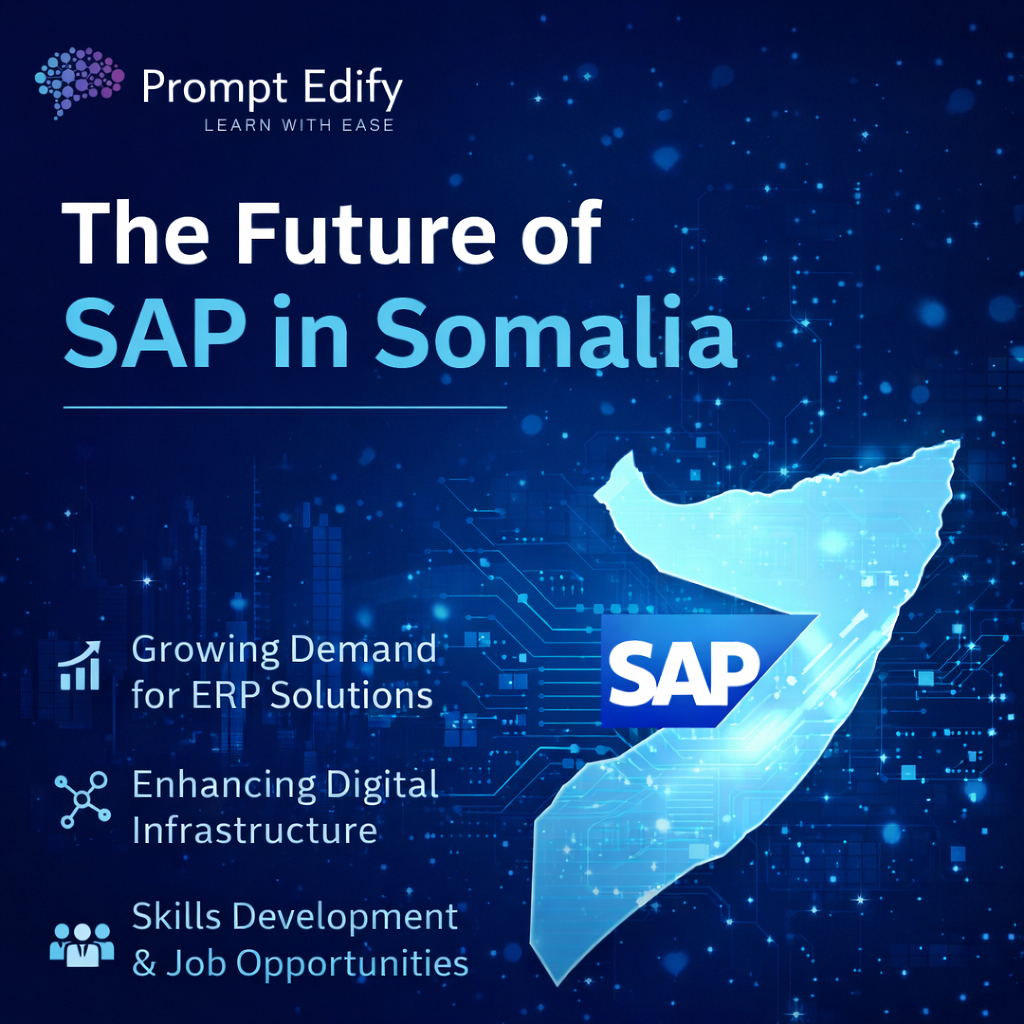
Somalia's move to modernize through digitization will be driven by the use of cloud-based business software, such as SAP Business Software. Companies that are investing now in migrating to SAP S/4HANA will position themselves to be market leaders in a global marketplace. The integration of new technology into SAP-based systems (like AI, Internet of Things, and advanced analytics) will speed up the innovation and growth of businesses in Africa.
For Somalia's expanding digital economy, moving to a cloud-based SAP environment is strategically important. By upgrading from Legacy Systems to ECC and S/4HANA, as well as utilizing tools like the SAP S/4HANA Migration Cockpit, organizations can achieve improved efficiency and develop innovative solutions. An appropriate choice of SAP S/4HANA Migration Strategy helps businesses to transform more rapidly and gain success in an ever-changing digital economy.
By Team Prompt Edify
Have any enquiry? Call us
+(27) 740294414
(+91) 99932-86938
wecare@promptedify.com


Prompt Edify Africa (PTY) Limited
2nd Floor, Rivonia VillageCnr Mutual Road and Rivonia Boulevard Rivonia Village, 2191
Johannesburg , South Africa
Contact : +27740294414
Prompt Edify East Africa Limited
KN 78 ST, Kagarama, Kigali, Kigali, Nyarugenge, Umujyi wa Kigali, Rwanda
Contact : +250 727 845 771
Prompt Edify Private Limited
4th Floor #15, City Vista Tower, Fountain Road,
Kharadi, Pune(MH), India.
PIN- 411014
Contact : (+91) 99932 86938



Contact Us Today!
+27740294414 | (+91) 99932 86938 | +250 727 845 771
contact@promptedify.com | wecare@promptedify.com
🌐 https://promptedify.co.za/