
Enterprises in N’Djamena are adopting SAP S/4HANA to replace legacy SAP ECC systems and modernize their ERP infrastructure. This shift enables real-time analytics, streamlined operations, and stronger digital transformation strategies.
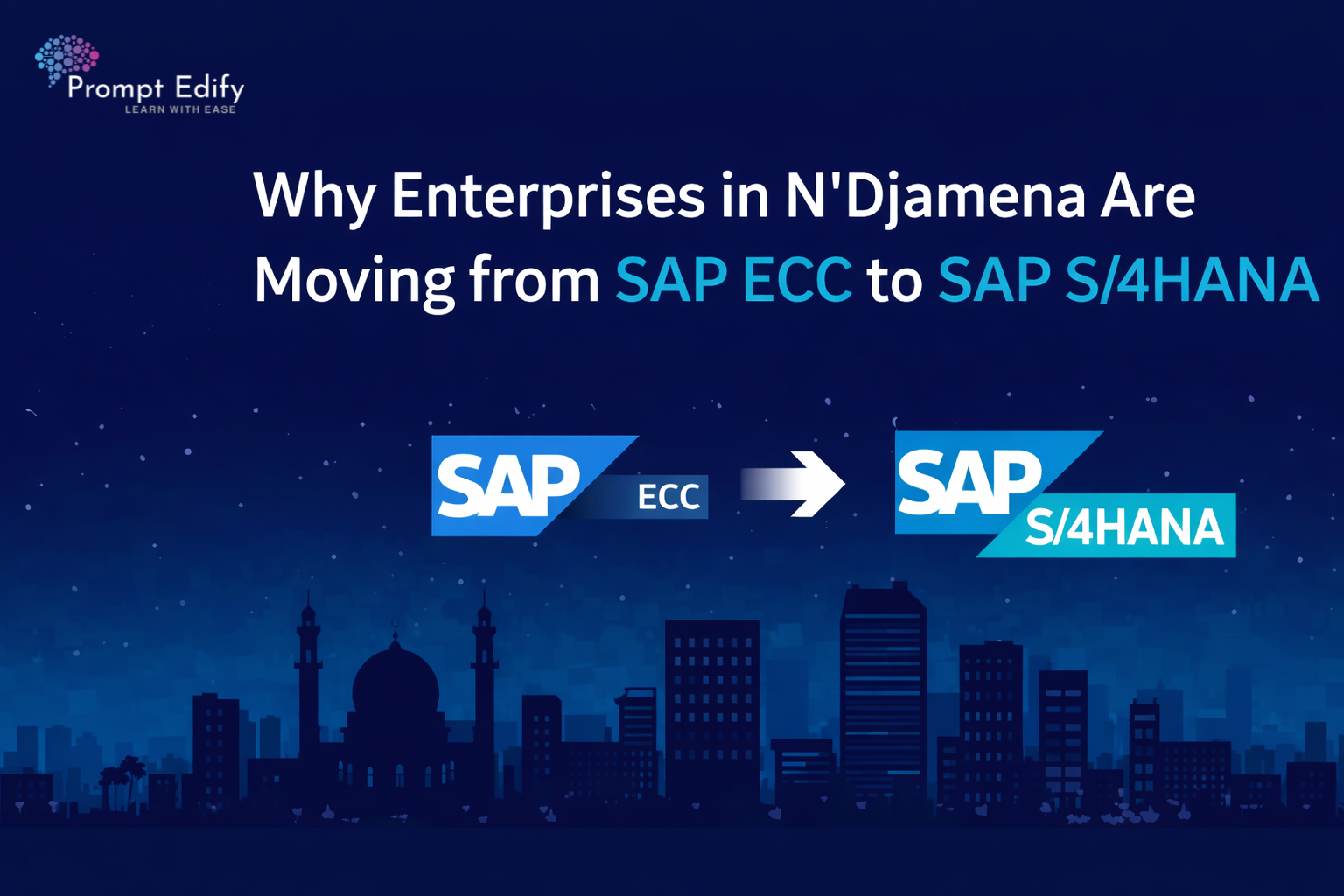
Many businesses located in Chad are going through an incredible change when it comes to technology use. Corporations, no matter whether they work within oil & gas, telecommunications, banking, or logistics, and including public sectors, are upgrading their enterprise systems to remain competitive in a world that is changing rapidly, and are using modern true Enterprise Resource Planning Solutions (ERP) instead of an SAP ECC system. Many organizations have already started exploring SAP S/4HANA Migration opportunities and are also considering SAP On-Premise to Cloud Migration as part of their long-term digital strategy.
The current transformational change from legacy systems will provide organizations with streamlined operational processes, real-time visibility to their operations, and will allow them to become more agile as a business - the future of Business is enterprise intelligence. Organizations located in N’Djamena, Chad, are evaluating their options for investing in SAP S/4HANA Migration opportunities as a path toward building their enterprise for IT sustainability in light of the upcoming end of SAP ECC support date. Many enterprises are therefore planning a structured Legacy System Upgrade while aligning their roadmap with a strong SAP S/4HANA Migration Strategy.
Numerous businesses in N'Djamena currently use old ERP systems such as SAP ECC that were first introduced over 10 years ago. While these have helped many businesses succeed over the years, they are now becoming harder to manage, connect with new technologies, and implement into the current digital economy. Because of this, organizations are focusing on Legacy System Upgrade initiatives and are also preparing their systems for ECC to S/4HANA transformation.
Upgrading from a legacy system is important for companies to maintain their competitive advantage, gain efficiencies, and grow. Businesses planning modernization projects often combine a SAP S/4HANA Migration Strategy with SAP On-Premise to Cloud Migration to improve scalability and reduce long-term infrastructure costs.
Legacy systems tend not to include things like advanced analytics, real-time reporting, and integration with emerging technologies, including AI, cloud computing, and the Internet of Things (IoT). Because of these limitations, organizations are prioritizing SAP S/4HANA Migration while also investing in a structured Legacy System Upgrade to modernize their IT infrastructure.
Moving to SAP S/4HANA provides businesses with access to a next-generation ERP based on the in-memory database SAP HANA, providing faster processing of data, easier data models, and real-time business insights that were not achievable through traditional ERP frameworks. Many companies see this transformation as a crucial step in their ECC to S/4HANA journey while implementing a reliable SAP S/4HANA Migration Strategy.
Transitioning from ECC to S4HANA is much more than just an upgrade of the current ERP system. The move to SAP S4HANA represents a true transformation of your entire ERP environment and will enhance organizations’ ability to support digital business models and operate their finance, supply chain, procurement, and HR functions in a more efficient manner. This transformation is commonly referred to as ECC to S/4HANA and is often executed through a well-defined SAP S/4HANA Migration Strategy.
In N’Djamena, organizations have several key reasons for transforming from ECC to S4HANA.
During the migration process, the SAP S/4HANA migration cockpit can be an extremely helpful tool; its purpose is to make it easier to transfer data from your old systems or SAP ERP (ECC) environment into the new SAP S/4HANA environment while supporting the overall SAP S/4HANA Migration journey.
Through the use of the migration cockpit to migrate to S/4HANA, companies will be able to do the following:
For companies located in N’Djamena, the use of SAP S/4HANA migration cockpit can help simplify the migration process and reduce the complexity of the data migration project. In addition to this, it provides organizations with a process and procedure that will allow them to successfully transition from ECC to S/4HANA.
Choosing the most effective SAP S/4HANA Migration Strategy is fundamental in ensuring that the implementation meets project objectives while supporting a successful SAP S/4HANA Migration.
Organizations typically consider one of three primary migration styles:
Companies in N'Djamena are looking closely at all three options as they evaluate how best each will benefit their company based upon their overall Corporate Goals, IT Infrastructure, and Budget provide for by the Corporate Entity.
Organizations that want to modernize their ERP systems can take advantage of many benefits associated with migrating to SAP S/4HANA Migration while aligning modernization with SAP On-Premise to Cloud Migration initiatives.
Increased Operational Efficiency: By streamlining workflows and automating repetitive processes, S/4HANA increases productivity within departments while supporting a smooth ECC to S/4HANA transformation.
Improved Decision Making: Business leaders can quickly make data-driven decisions using S/4HANA's real-time reporting and analytics through a structured SAP S/4HANA Migration Strategy.
Increased Scalability: As organizations expand into new markets, S/4HANA will accommodate this variation without difficulty through effective SAP S/4HANA Migration planning.
Enhanced Integration Capabilities: With modern APIs and cloud compatibility, S/4HANA can easily integrate with other enterprise applications, particularly during SAP On-Premise to Cloud Migration initiatives.
Reduced Complexity in IT: With a simplified data model and modern architecture, S/4HANA will reduce the cost of maintaining systems and operating costs after completing ECC to S/4HANA projects.
In conclusion, implementing advanced ERP systems, such as SAP S/4HANA, will improve operational performance and increase competitiveness in the global economy of emerging economies like Chad.

The number of enterprises undertaking SAP S/4HANA Migration projects in N'Djamena is increasing, which means that there's also a corresponding increase in demand for experienced SAP consultants who can guide organizations through ECC to S/4HANA transitions.
To achieve a successful migration to SAP S/4HANA, organizations must have experience and specialized knowledge in areas such as system architecture, data migration, integrations, and change management supported by a well-defined SAP S/4HANA Migration Strategy.
SAP consulting partners help organizations with the following:
Using an experienced SAP consulting partner to help with the migration project reduces the risks associated with the transition and ensures that the outcome of the migration provides long-term business benefits.
Transitioning from SAP ECC to SAP S/4HANA is essential for enterprises in N'Djamena as they work toward digital transformation. Companies are ramping up their modernization efforts to make better decisions and compete in a digital-first economy, so migrating to SAP S/4HANA Migration has become an important strategic priority supported by ECC to S/4HANA initiatives.
Through the appropriate Legacy System Upgrade, a well-thought-out SAP S/4HANA Migration Strategy, and tools like the SAP S/4HANA migration cockpit, organizations can effectively migrate from ECC to S/4HANA and leverage the complete capabilities of cutting-edge technology available to businesses today.
Businesses that act quickly and seek experienced SAP consultants will position themselves to utilize advanced analytics, automation, and scalable ERP solutions that promote future expansion.
By Team Prompt Edify
Have any enquiry? Call us
+(27) 740294414
(+91) 99932-86938
wecare@promptedify.com

Prompt Edify Africa (PTY) Limited
2nd Floor, Rivonia VillageCnr Mutual Road and Rivonia Boulevard Rivonia Village, 2191
Johannesburg , South Africa
Contact : +27740294414
Prompt Edify East Africa Limited
KN 78 ST, Kagarama, Kigali, Kigali, Nyarugenge, Umujyi wa Kigali, Rwanda
Contact : +250 727 845 771
Prompt Edify Private Limited
4th Floor #15, City Vista Tower, Fountain Road,
Kharadi, Pune(MH), India.
PIN- 411014
Contact : (+91) 99932 86938



Contact Us Today!
+27740294414 | (+91) 99932 86938 | +250 727 845 771
contact@promptedify.com | wecare@promptedify.com
🌐 https://promptedify.co.za/